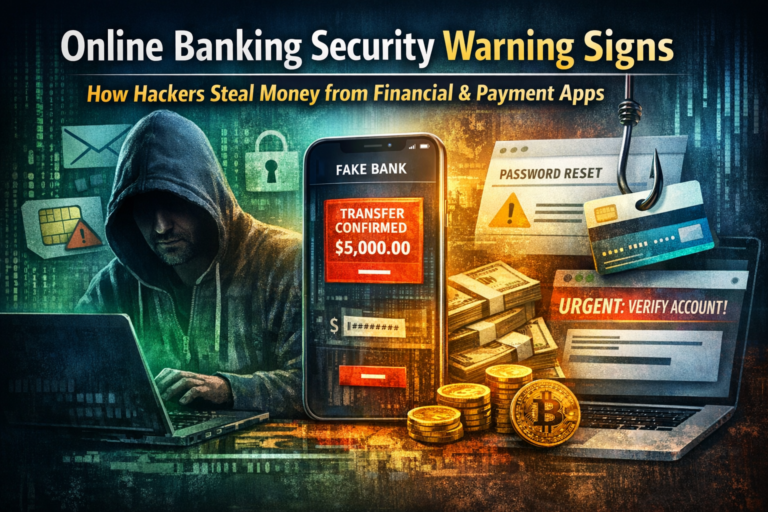
Most financial account takeovers do not begin inside your banking app.
They begin with identity compromise.
By the time money disappears, the attacker has already:
• Accessed your email
• Intercepted a verification code
• Passed a recovery check
• Or manipulated you into approving something that looked legitimate
Modern financial attacks are rarely “brute force hacks.”
They are layered manipulations built on weak recovery systems, phone vulnerabilities, and psychological triggers.
If you understand how they actually work, you can stop them before money moves.
Step One: Email Is the Master Key
Your email account is the reset center for your financial life.
If someone controls your email, they can:
• Reset your banking password
• Approve recovery requests
• Delete fraud alerts
• Change your security settings
Many victims never realize their email was compromised first.
That’s why financial protection starts with identity protection.
👉 Strengthen your foundation here:
/identity-account-security/
If your email isn’t locked down, your banking app isn’t either.
Step Two: SMS & SIM Swap Exploitation
Many banks and payment apps still rely on SMS one-time passcodes.
Attackers exploit this through:
• SIM swap fraud
• SMS phishing links
• Malware that reads text messages
• Social engineering that tricks you into sharing codes
Once an attacker controls your phone number, SMS-based authentication becomes useless.
The system works exactly as designed — but it verifies the attacker.
This is why mobile hardening matters.
👉 See how phone compromise happens:
/device-mobile-security/
App-based authentication dramatically reduces this risk.
Step Three: Recovery Settings Are the Weakest Link
Most people set up accounts once and never review recovery options again.
Common weaknesses:
• Old phone numbers still attached
• Inactive backup emails
• Guessable security questions
• MFA disabled “temporarily”
Attackers don’t break encryption.
They exploit recovery workflows.
If recovery is weak, everything is weak.
Step Four: Financial Scams Don’t Always Hack You
Sometimes the system isn’t breached.
You approve the transaction yourself.
Examples:
• Fake crypto investment platforms
• Urgent payment impersonation
• Refund reversal scams
• Customer support impersonation
• “Account verification” pressure tactics
These attacks rely on urgency, authority, and fear.
Recognizing the psychological pattern is critical.
👉 Learn the warning signs here:
/online-scam-warning-signs/
Most financial theft is manipulation, not technical wizardry.
Step Five: Malware & App Clones
Attackers also use:
• Fake banking app clones
• Trojanized updates
• Keylogging malware
• Overlay attacks that capture credentials
These methods rely on device compromise.
Layered protection is what blocks them.
Warning Signs Your Financial Accounts Are at Risk
Watch for:
• Password reset emails you didn’t request
• New devices listed in account settings
• MFA disabled notifications
• Small “test” charges
• Carrier service interruptions (possible SIM swap)
• Login attempts from unknown locations
Small irregularities are often the early stage of takeover.
Ignoring early warnings allows large losses.
How to Actually Lock Down Financial & Payment Apps
Real protection requires layers.
Start here:
- Secure your email first.
- Use app-based authentication instead of SMS alone.
- Lock your SIM with carrier-level protection.
- Remove outdated recovery options.
- Review connected devices monthly.
- Use reputable security tools on your devices.
If you want the complete layered framework:
👉 /the-5-layers-of-online-security/
And if you want the simplified step-by-step version:
👉 /free-online-security-guide/
Most people rely on one layer.
Attackers rely on that.
Layered security forces them to move on.
The Pattern Behind Every Financial Attack
Nearly every successful financial theft uses one or more triggers:
Urgency
Authority
Fear
Opportunity
Isolation
If you recognize the pattern, you interrupt the attack before money moves.
Awareness is not paranoia.
It’s protection.
Final Thought
Financial theft rarely starts in your bank.
It starts in your inbox.
Or your phone.
Or your recovery settings.
Secure those first.
Then your money becomes much harder to reach.
If you’re building your security stack, you can also review:
👉 /tools-for-everyday-online-safety/