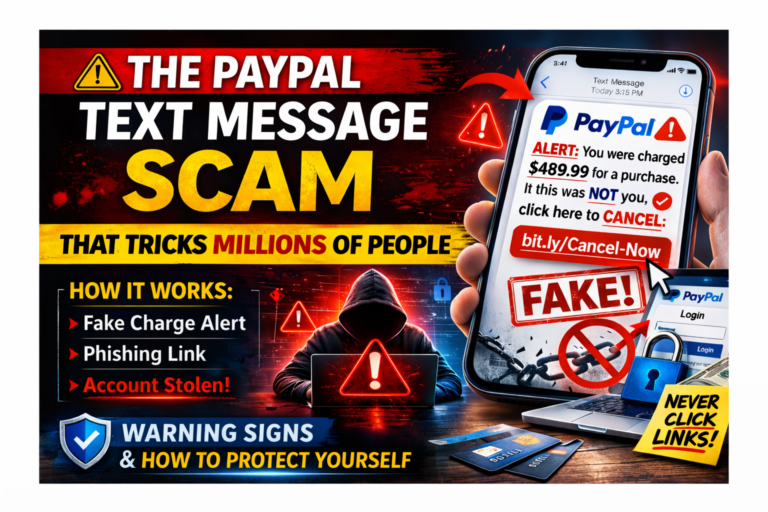
Over the past few years I’ve received several text messages claiming that my PayPal account had been charged for a purchase.
The message usually looked something like this:
PayPal Alert: Your account has been charged $489.99 for a purchase.
If this wasn’t you, click here to cancel the transaction.
Naturally, the first reaction is panic.
You immediately think:
“I didn’t buy anything.”
The message includes a link that appears to go to PayPal.
But instead of clicking the link, I did something very simple.
I ignored the message and went directly to PayPal.com to check my account.
Every time, there was no charge at all.
That’s when it becomes obvious that the message is part of a PayPal text message scam designed to trick people into clicking phishing links.
How the PayPal Text Message Scam Works
The PayPal text message scam is a form of phishing known as “smishing”, which uses text messages instead of emails.
Scammers send thousands of fake messages claiming that a suspicious charge has been made on your PayPal account.
The goal is simple.
They want you to panic and click the link.
Once you click the link, several things may happen.
The page may open a fake PayPal login screen that looks identical to the real website. If you enter your email and password, those credentials are sent directly to the scammers.
In some cases, the fake page asks you to verify your payment information, collecting credit card numbers and personal details.
Some phishing links even install malware designed to steal information from your device.
Why the PayPal Text Message Scam Works
The PayPal text message scam works because it creates urgency.
If someone believes money was just taken from their account, their instinct is to act quickly.
Scammers take advantage of that fear.
They want victims to react immediately without stopping to think about whether the message is legitimate.
The Simple Rule That Stops Most Phishing Scams
There is one habit that prevents most phishing attacks, including the PayPal text message scam.
Never click login links in text messages or emails.
Instead, always go directly to the official website or open the official mobile app.
That’s exactly what I did.
By going straight to PayPal instead of clicking the message link, I avoided what could have been a costly mistake.
Who Is Most Vulnerable
One of the most concerning things about the PayPal text message scam is that many people still trust messages that appear official.
Older adults are often targeted because scammers assume they may not recognize phishing tactics.
Criminals rely on people believing the message and clicking without questioning it.
That’s why awareness is so important.
How to Protect Yourself From the PayPal Text Message Scam
Here are a few simple steps that can help protect your accounts.
• Never click links in unexpected financial alerts
• Always log in directly through the official website or app
• Enable two-factor authentication on important accounts
• Watch for strange domain names or misspellings
Small habits like these can prevent serious problems.
Final Thoughts
The PayPal text message scam is just one example of how modern phishing attacks work.
These scams are becoming more sophisticated every year, and many victims only realize what happened after their account has already been compromised.
Learning how these scams work is one of the best ways to protect yourself online.
If you’d like a simple step-by-step system to secure your accounts, download my Free Internet Security Guide Here.