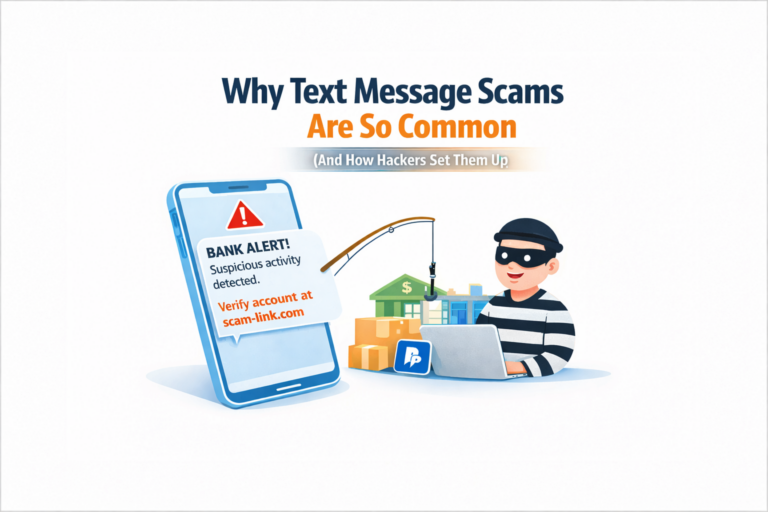
Why Text Message Scams Work So Well
If you’ve noticed that text message scams are becoming more common, you’re not imagining things.
Messages claiming to be from banks, delivery companies, PayPal, or government agencies have become one of the most popular ways criminals start online attacks.
These scams often begin with a simple message designed to create urgency or fear.
These messages often say things like:
- “Suspicious activity detected on your bank account.”
- “Your package could not be delivered.”
- “Your PayPal account was charged.”
- “Unpaid toll detected on your vehicle.”
The message usually includes a link or a phone number.
What many people don’t realize is that these scams are often part of organized operations designed to steal personal information, money, or account access.
Understanding how these scams work is one of the best ways to protect yourself.
You can find more examples like this in the Online Scam Warning Signs section of this site.
Why Scammers Prefer Text Messages
Text message scams are extremely popular for one simple reason: they work.
There are several reasons criminals prefer SMS scams over email.
Text Messages Reach You Immediately
Unlike email, which may be filtered into spam folders, text messages appear directly on your phone.
Most people read text messages almost immediately after receiving them.
People Trust Messages From Their Phones
Many people assume text messages come from trusted sources like friends, family, or companies they do business with.
Because of this, people are more likely to click links in a text message than links in an email.
Text Messages Create Urgency
Scam messages often create fear or urgency.
Messages may warn about:
- suspicious bank activity
- unpaid bills
- delivery problems
- account security alerts
When people believe something is wrong with their money or accounts, they often react quickly without thinking carefully.
Many of these scams target financial accounts, which is why understanding Financial & App Security is so important.
How Scammers Get Your Phone Number
Many people believe scammers somehow targeted them personally.
In reality, most scammers are simply sending messages to large lists of phone numbers.
These numbers usually come from several sources.
Data Breaches
When websites are hacked, databases containing user information are often stolen.
These databases may include:
- phone numbers
- email addresses
- names
- passwords
Criminal groups buy and sell these lists online.
Online Forms and Registrations
Many websites ask users to provide phone numbers when signing up for services.
In some cases this information is leaked, sold, or poorly protected.
Random Number Messaging
Some scammers simply send automated messages to thousands of randomly generated phone numbers.
Even if only a small percentage of people respond, the scam can still be profitable.
Social Media Information
People sometimes expose personal details through social media accounts or online listings.
This information can be used by scammers to build targeted attack lists.
Protecting your accounts and identity information is a key part of Identity & Account Security.
How Hackers Set Up Text Message Scams
Most SMS scams follow a very predictable process.
Step 1 — Collect Phone Numbers
Scammers gather large databases of phone numbers from breaches, online sources, or purchased lists.
Step 2 — Send Thousands of Messages
Using automated tools, scammers send thousands of text messages at once.
These messages often impersonate:
- banks
- PayPal
- Amazon
- delivery companies
- government agencies
Step 3 — Redirect Victims to Fake Websites
Links in the messages often lead to websites designed to look like legitimate services.
Victims may be asked to:
- log into an account
- enter payment details
- confirm personal information
Step 4 — Use the Stolen Information
Once criminals collect login credentials or financial information, they may:
• steal money from accounts
• take over social media profiles
• sell personal data
• run additional scams
You can see a real example of this type of attack in the article about a bank text message scam.
How Scammers Make Messages Look Legitimate
Many scam messages appear to come from trusted companies.
This is often done using a technique called SMS spoofing.
SMS spoofing allows attackers to change the name or number that appears as the sender.
Instead of showing a random number, the message might appear to come from names such as:
- PayPal
- Amazon
- Bank Alert
- FedEx
- USPS
In some cases the scam message may even appear inside the same message thread as legitimate alerts, making it look extremely convincing.
The SIM Swap Scam: When Hackers Steal Your Phone Number
One of the most dangerous phone-related attacks today is known as SIM swap fraud.
Instead of tricking victims into clicking links, attackers attempt to take control of the victim’s phone number.
How SIM Swap Attacks Work
Hackers gather personal information about the victim and contact the mobile carrier pretending to be the account owner.
They claim their phone was lost or damaged and request that the phone number be transferred to a new SIM card.
Once the carrier moves the number, the victim’s phone suddenly loses service.
Meanwhile the attacker receives all incoming calls and text messages.
This type of attack targets weaknesses in Device & Mobile Security.
Why SIM Swap Attacks Are Dangerous
Many online services rely on text messages for security verification.
These messages are used for:
- password resets
- login authentication codes
- account recovery
If criminals control your phone number, they may be able to reset passwords for accounts like:
- email accounts
- banking apps
- cryptocurrency wallets
SIM swap scams have been responsible for millions of dollars in stolen funds.
Warning Signs of a Text Message Scam
Even when a message appears legitimate, there are often warning signs.
Watch for:
• messages creating urgency or fear
• links to unfamiliar websites
• requests for personal or financial information
• messages asking you to log in through a link
If you receive a message about your account, it is safer to open the official website or app directly instead of clicking the link.
How to Protect Yourself From Text Message Scams
There are several ways to reduce your risk.
Never Click Unexpected Links
If a message claims to be from a bank or company, visit the official website or app instead.
Use Strong Unique Passwords
Password reuse makes it easier for hackers to take over accounts.
Enable Two-Factor Authentication
Two-factor authentication adds another layer of protection.
However, SMS authentication has limitations, which you can learn about in the guide on SMS two-factor authentication safety.
Secure Your Email Account
Email accounts are often the gateway to many other accounts.
Understanding how hackers take over email accounts can help you prevent larger security problems.
Knowledge Is Your Best Defense
Many of these attacks follow patterns that security experts see repeatedly. If you want to understand the most common tactics criminals use, review the online scam warning signs that appear in many modern phishing and text message scams.
Text message scams succeed because many people simply don’t understand how these attacks work.
Once you understand how scammers gather phone numbers, send spoofed messages, and steal information, it becomes much easier to recognize suspicious messages and avoid becoming a victim.
If you want a simple step-by-step system for protecting your accounts, devices, and online identity, download the Free Online Security Guide.
It explains the security layers most people overlook and how to secure your digital life in about an hour.