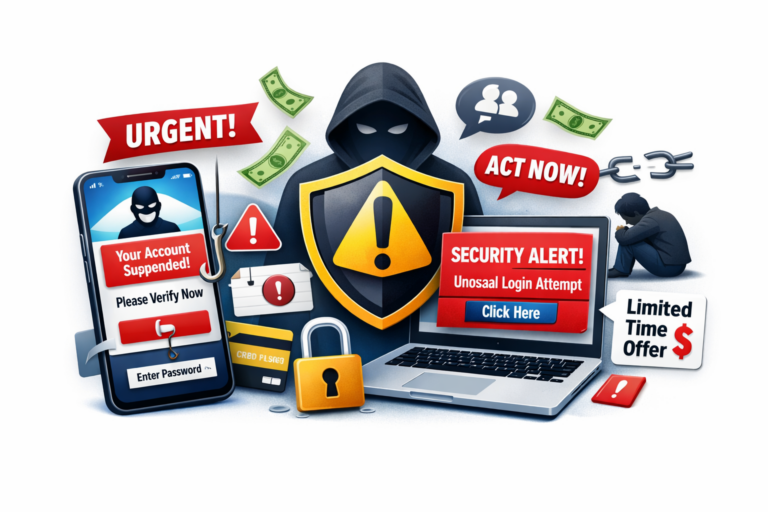
Online scams are not random attacks.
They are structured psychological operations designed to trigger predictable human reactions.
If you understand the warning signs of modern scams — and the psychology behind them — you can stop most attacks before they cost you money, access to your accounts, or even your identity.
This guide explains how online scams really work, what warning signs to look for, and how to protect yourself using layered security.
The Truth About Modern Online Scams
Most successful scams do not rely on advanced hacking tools.
Instead, they rely on manipulation.
Scammers don’t usually “break into” your accounts technically.
They trick you into giving them access willingly.
They exploit emotion — not technology.
That’s why education and pattern recognition matter more than memorizing every new scam variation.
The 5 Core Online Scam Warning Signs
After years in IT and investigating compromised accounts, one pattern became obvious:
Nearly every scam relies on one or more of five psychological triggers.
I call this the SecureWithVPN Scam Psychology Framework™.
Recognizing these warning signs early is what prevents financial loss and account compromise.
1️⃣ Urgency – “Act Immediately”
Common examples:
- “Your account will be locked within 30 minutes.”
- “Immediate verification required.”
- “Respond now to avoid suspension.”
Urgency creates stress.
When stress increases, logical thinking decreases.
Scammers intentionally apply time pressure because they don’t want you verifying the message independently.
Legitimate institutions do not punish you for taking a few minutes to confirm through their official website.
If someone is rushing you, that is your first major warning sign.
2️⃣ Authority Impersonation – Borrowed Trust
Scammers frequently impersonate:
- Banks
- Facebook security teams
- Crypto exchanges
- Government agencies
- Mobile carriers
The goal isn’t perfection — it’s familiarity.
If something looks official enough, the brain relaxes.
But appearance is not proof.
Never click the login link provided in an email or text.
Instead, navigate directly to the official website yourself.
For example, many social media takeovers begin with fake security alerts. If you want to understand how these attacks unfold, read:
👉 How Facebook Accounts Get Hacked
Authority without independent verification is a red flag.
3️⃣ Fear – Emotional Narrowing
Fear changes how your brain processes information.
You might see messages like:
- “Suspicious login attempt detected.”
- “Fraud alert.”
- “Your SIM card has been compromised.”
- “Illegal activity on your account.”
Fear narrows your focus.
Instead of thinking clearly, you react to eliminate the threat.
This is how phishing emails work — especially those targeting email accounts and financial platforms.
If you want to see how email-based attacks unfold step by step, read:
👉 How Hackers Take Over Email Accounts
The warning sign is not just the message.
It’s the emotional spike you feel.
Pause before reacting.
4️⃣ Greed or Opportunity – The Excitement Trap
Not all scams threaten you.
Some tempt you.
Examples include:
- Guaranteed crypto profits
- Early investment access
- Prize winnings
- “Limited-time” financial opportunities
Excitement suppresses skepticism.
If something promises certainty in uncertain markets, that is a warning sign.
Real investments tolerate scrutiny.
Scams require speed.
5️⃣ Isolation – The Hidden Manipulation Tool
Isolation is the most overlooked tactic.
Scammers often:
- Keep you on the phone
- Move conversations to WhatsApp or Telegram
- Tell you not to contact your bank yet
- Say involving others will “cancel” the opportunity
Why?
Because outside perspective destroys scams instantly.
The moment you calmly explain the situation to a third party, the manipulation becomes obvious.
If someone discourages independent verification, treat that as a major red flag.
How These Warning Signs Combine
Modern scams stack triggers.
Example:
“You have suspicious activity on your crypto wallet (fear).
Log in immediately to secure your funds (urgency).
This is the official security team (authority).”
That combination overwhelms rational thinking.
Recognizing the structure is how you break the cycle.
Common Modern Scam Types (And the Warning Signs They Use)
SIM Swap Attacks
In a SIM swap, a scammer convinces your mobile provider to transfer your number to their SIM card.
Once they control your number, they intercept one-time passwords and reset accounts.
If you want to understand the early indicators that your mobile device may already be compromised, read:
👉 Signs Your Phone May Be Compromised
Warning signs involved:
- Authority impersonation
- Urgency
- Isolation
Strong phone security is critical here.
Public Wi-Fi Exploitation
Attackers can create fake Wi-Fi hotspots that mimic legitimate networks in cafes and airports.
Users connect assuming safety.
To understand how attackers exploit unsecured connections, read:
👉 Public Wi-Fi Security Risks – How Hackers Exploit Unprotected Connections
Warning signs involved:
- False familiarity
- Convenience
- Lack of encryption
Layered network protection reduces this risk significantly.
Crypto Phishing Emails
These emails claim:
- “Security update required.”
- “Wallet verification needed.”
- “Unusual login attempt.”
Victims enter credentials into fake websites that look nearly identical to legitimate platforms.
Triggers used:
- Fear
- Urgency
- Authority impersonation
Never log in through an email link.
Why Intelligent People Still Get Scammed
Scams are not about intelligence.
They are about emotional timing.
Most successful scams occur when someone is:
- Distracted
- Tired
- Stressed
- Excited
- Rushed
Under emotional pressure, even technically knowledgeable people can make mistakes.
That’s why layered protection matters.
If you haven’t read it yet, start here:
👉 The 5 Layers of Online Security
Layered systems reduce the damage even when human error happens.
What To Do If You Notice Scam Warning Signs
If something feels wrong:
- Stop immediately.
- Do not click additional links.
- Navigate directly to the official website.
- Change passwords from a secure device.
- Enable multi-factor authentication.
- Monitor financial accounts closely.
- Contact institutions through official channels only.
Calm verification defeats manipulation.
Build Protection Layers — Not Reactions
Security is not one tool.
It’s a system:
- Identity protection
- Phone security
- Financial account security
- Device protection
- Network security
When these layers work together, most scams fail automatically.
If you want a simple step-by-step breakdown of how to build those layers correctly, download:
👉 Free Internet Security Guide
Final Thought
Online scams succeed because psychology is predictable.
But once you understand the warning signs — urgency, authority, fear, greed, and isolation — you begin to see the manipulation before it works.
You stop reacting emotionally.
You start verifying intelligently.
And that shift is what protects your accounts — and your money.